
Comparisons
SendPortal Review: SendPortal vs SendHQ for Product and Newsletter Email
SendPortal is a free, MIT-licensed, self-hosted Laravel app for newsletters. What it costs to run, its limits, and how it compares with SendHQ.
Published · Updated
TL;DR: SendPortal is a free, open-source (MIT) email marketing app you host yourself: a Laravel application that sends newsletters and campaigns through your own Amazon SES, Postmark, SendGrid, Mailgun, Mailjet, Postal or SMTP account. SendHQ is a hosted email API for products and AI agents, with sending, inbound email and delivery events in one workspace from $9 a month. Pick SendPortal if you want to own a newsletter tool and are happy to run PHP, a database, a queue and a cron job; pick SendHQ if you want product email and replies working without operating a server.
Create a SendHQ workspace and send your first email
What is SendPortal, in one paragraph? SendPortal describes itself as "Open-source self-hosted email marketing. Manage your own newsletters at a fraction of the cost." It is built by Mettle, released under the MIT license on GitHub (2,192 stars and 55 open issues when we read it on 15 November 2026), and its latest major release, v4.0.0, shipped on 12 October 2026, followed by v4.0.0.1 on 22 October. SendPortal itself costs nothing. What you pay for is the server it runs on, the database, and the email service that actually delivers the mail. It does campaigns, lists, segments, templates and tracking well; it is not a transactional email API and it does not receive email.
SendPortal vs SendHQ at a glance
| Criteria | SendHQ | SendPortal |
|---|---|---|
| What it is | Hosted email API and workspace for products and AI agents | Self-hosted email marketing app (Laravel) |
| Price of the software | Starter $9/month (50,000 transactional emails), Scale $39/month (200,000) | Free, MIT license |
| Who delivers the mail | SendHQ's managed sending infrastructure | Your own SES, Postmark, SendGrid, Mailgun, Mailjet, Postal or SMTP account |
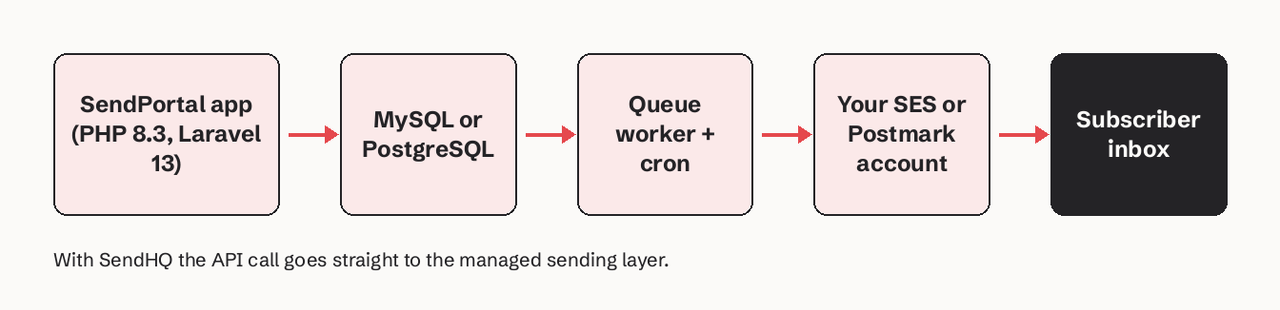
| What you operate | Nothing; DNS records for your domain | PHP 8.3+, Laravel 13, MySQL or PostgreSQL, a queue, a cron job |
| Main job | Transactional, inbound and agent email through one API | Newsletters and campaigns to subscriber lists |
| Inbound email | Included on every plan | Not offered |
| Unsubscribe handling | Marketing plans add a signed unsubscribe link and one-click unsubscribe headers | Unsubscribe tracking per campaign |
| Multiple brands | 25 verified domains (Starter), 100 (Scale) | Unlimited workspaces, users, subscribers and messages |
| Free option | Integration trial: 100 deliveries to your own address or a simulator | The software is free; provider and hosting costs apply |
Sources: sendhq.cc/pricing, sendportal.io, the SendPortal README and installation docs, all read 15 November 2026.
What SendHQ does for teams looking at SendPortal
SendHQ is the hosted option for the email a product sends and receives. For someone weighing SendPortal, the useful specifics are:
- No server to run. You add a domain, publish the DNS records, create an API key and send. There is no PHP runtime, queue worker or cron job to keep alive.
- Sending and receiving together. Every plan includes verified-domain sending, inbound email, delivery events and API access, so replies land in the same workspace as the mail that triggered them.
- Marketing email with the safety rails built in. The Marketing plans ($19 a month for Starter, $39 for Scale) carry a signed unsubscribe link and one-click unsubscribe headers automatically and honor unsubscribe and suppression state.
- Flat plans. Starter is $9 a month for 50,000 transactional emails; Scale is $39 a month for 200,000. There are no automatic overage charges: sends past the allowance are rejected with a usage-limit error.
- Visible sender rules. Each sender address starts at 2,000 recipients a day and rises to 10,000 and then 50,000 after clean sending, and the bounce and complaint thresholds are published on the pricing page.
Where SendHQ stops: it has no subscriber list manager with segments and a campaign editor like SendPortal's, and it is not open source. If a drag-and-send newsletter UI over your own lists is the whole job, SendPortal is built for exactly that.
Who is SendPortal built for, and what is it?
The homepage pitch is "Huge savings compared to MailChimp, Campaign Monitor and others." In practice that means a Laravel team that would rather own its newsletter database than rent one per subscriber. Feature highlights from the project page:
- CSV import plus tag-based segments
- A template editor
- Per-campaign reports
- Several brands per installation
- An optional embedded mode:
mettle/sendportal-coredrops into an existing Laravel app that already handles login
Good fits: an indie SaaS announcing releases to opt-in users, an agency running newsletters for several clients, a developer who wants MIT-licensed code they can fork. Poor fits: one-time codes, password resets, order receipts, agent conversations. Those are request-driven messages that need a send-one-email endpoint, and usually a reply path too.
What does SendPortal cost to run?
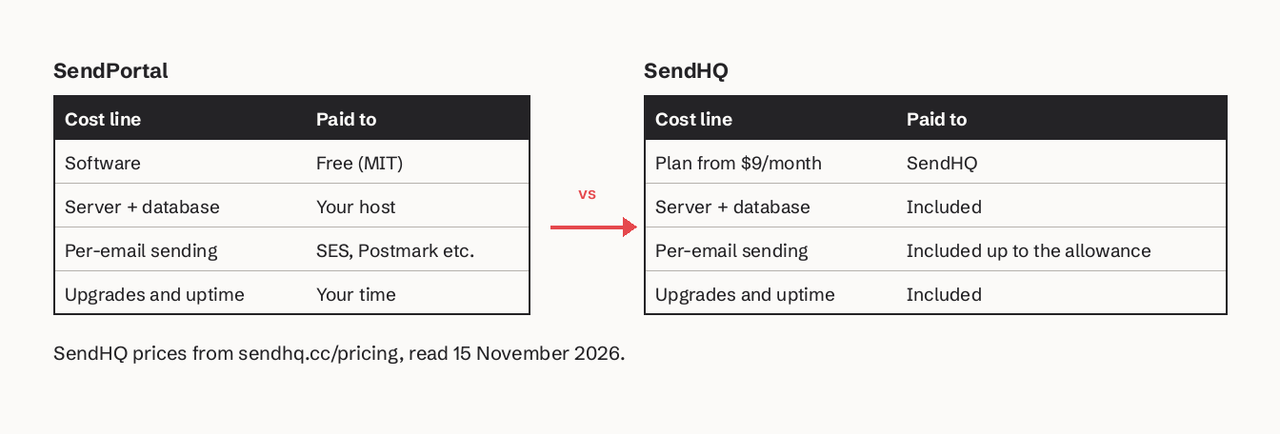
The software is free under the MIT license. The real cost has three parts:
- Hosting. A server or container that runs PHP 8.3+ and a MySQL (5.7 or later) or PostgreSQL (10 or later) database, plus Redis if you follow the docs' advice for larger lists.
- The email service. SendPortal does not deliver mail itself. You connect a workspace to Amazon SES, Postmark, SendGrid, Mailgun, Mailjet, Postal or SMTP and pay that provider per email. Amazon SES, the usual low-cost pick, now prices outbound mail per email under plans and volume tiers, and new SES accounts start on its Essentials plan from 21 July 2026 (AWS SES pricing). Check the current rate for your volume there before you budget.
- Your time. Installing, upgrading (v3 to v4 needs PHP 8.3 and Laravel 13), keeping workers running, and handling provider setup such as SES production access and bounce webhooks.
A SendHQ plan folds all three into one price: $9 a month for 50,000 transactional emails or $19 for 50,000 marketing emails, with no server to maintain. Use the email cost calculator to put both options next to each other at your volume.
What running SendPortal yourself takes
The configuration docs are clear about the moving parts. A working install needs:
# install and create the first user and workspace
php artisan sp:install

# cron entry: SendPortal's scheduler must run every minute
* * * * * cd /path-to-your-project && php artisan schedule:run >> /dev/null 2>&1

# without Horizon, one worker per queue
php artisan queue:work --queue=sendportal-message-dispatch
php artisan queue:work --queue=sendportal-webhook-process
Points that matter in production, all from the docs:
- The queue driver.
QUEUE_CONNECTIONcan besync,databaseorredis. Sync blocks the user until a job is done and is only for small sends; the database queue can slow your main database under load; Redis is "the recommended solution for running medium to large mailing lists." - Horizon. SendPortal bundles Laravel Horizon for Redis queues, autoscaling from a minimum of 2 processes to a maximum of 10 or 20 per queue, and the docs recommend Supervisor so it restarts after a failure.
- `APP_URL` must be set correctly or unsubscribe links break.
- Team email is separate. Invites and password resets need their own mail settings and
SENDPORTAL_REGISTER=true; this is unrelated to the provider each workspace sends campaigns through.
None of this is unusual for a Laravel app, and a PHP team will find it routine. It is still a service you own: if the worker stops, campaigns stop.
What are SendPortal's limits?
These are scope limits, not bugs:
- No inbound email. SendPortal sends; it does not receive or parse replies.
- Campaign-shaped, not request-shaped. It is built around lists and campaigns. Its API manages subscribers, tags, templates and campaigns; it is not a general send-one-message API for receipts or one-time codes.
- Deliverability is your provider's and yours. Domain authentication, bounce handling and reputation sit with whichever service you connect and with your own list hygiene.
- Self-hosting overhead. Upgrades follow the PHP and Laravel versions: v4 needs PHP 8.3 and Laravel 13, and teams on PHP 8.2 or Laravel 10/11 stay on v3.
- Community support. It is an open-source project with issues on GitHub (55 open when we checked), not a vendor with a support commitment.
How does SendHQ compare with SendPortal?
They overlap only on bulk, permission-based email. The deciding question is what kind of email you send.
Product and agent email (receipts, resets, alerts, replies). SendHQ. It is an API built for one-at-a-time messages with delivery events and inbound email on the same domain, and the transactional email API guide shows the request shape. SendPortal is not designed for this.
Newsletters to your own list, with a campaign editor. SendPortal, if you want a UI for lists and segments and are happy to host it. SendHQ's Marketing plans send permission-based email with unsubscribe and suppression enforcement through the API, but you bring the list logic.
Both, from one team. If you would rather not run a server for either, SendHQ covers product email and API-driven marketing sends; if you want to keep SendPortal for campaigns, it can still send through SES while your product email runs on SendHQ.
Choose SendHQ if
- You need transactional email, inbound email or an email API for AI agents.
- You don't want to run PHP, a database, Redis and a queue worker for email.
- You want a flat monthly price without overage charges.
Choose SendPortal if
- Your job is newsletters to an opt-in list and you want a full campaign UI.
- You already run Laravel and want the code under an MIT license.
- You want to pick and pay the delivery provider directly.
If you are setting up a domain for either, get DKIM, SPF and DMARC right first, and check it with the email DNS checker.
FAQ
Is SendPortal free?
Yes. SendPortal is open source under the MIT license, so the software costs nothing. You pay for hosting and for the email service it sends through, such as Amazon SES or Postmark.
Which email providers does SendPortal support?
The README lists Amazon SES, Postmark, SendGrid, Mailgun and Mailjet, and the docs also cover Postal and plain SMTP. Each workspace connects to its own provider.
Is SendPortal still maintained?
Yes, as of November 2026. Version 4.0.0 was released on 12 October 2026 and v4.0.0.1 on 22 October 2026; v4 requires PHP 8.3 and Laravel 13.
Can SendPortal send transactional email or receive replies?
It is built for campaigns to subscriber lists and does not receive email. For receipts, password resets and replies, use a transactional email API with inbound support such as SendHQ.
What is a good SendPortal alternative if I don't want to self-host?
If you need product email and inbound, SendHQ starts at $9 a month for 50,000 emails with no server to run. If you need a hosted newsletter editor, compare the newsletter tools on our comparison pages.