
Comparisons
6 Best SMTP2GO Alternatives for Developers (Compared)
The best SMTP2GO alternatives are Postmark, Mailgun, Amazon SES, Resend, SendHQ and Brevo. Compare pricing, SMTP plus API, inbound email and log retention.
Published · Updated
TL;DR: The strongest SMTP2GO alternatives are Postmark (transactional speed and 45-day logs), Mailgun (inbound routing and validation), Amazon SES (lowest per-email cost), Resend (developer API with a 3,000 email free tier), SendHQ (API plus inbound with a flat monthly cap) and Brevo (transactional plus marketing in one account). Pick by the one thing SMTP2GO is not giving you: price at your volume, inbound email, log retention or API design.
SMTP2GO is an SMTP relay and email API whose Starter plan costs $10 a month for 10,000 emails, with extra email at $1 per 1,000 and 30 days of reporting; Professional is $75 a month for 100,000 emails with a dedicated IP (SMTP2GO pricing, checked November 2026). Teams usually look for SMTP2GO competitors for one of four reasons: they need to receive email, not only send it; they want longer or more detailed logs; their volume makes a per-1,000 rate like Amazon SES's $0.10 attractive; or they want a REST API and webhooks designed around application code. The six alternatives below each win one of those cases. All prices come from each vendor's public pricing page on November 5, 2026.
How we judged these SMTP relay alternatives
We compared each provider on the criteria that decide a switch away from SMTP2GO:
- SMTP and REST API: can you keep your SMTP integration while moving new code to an API?
- Inbound email: can the provider receive mail and hand it to your app?
- Pricing at 10,000 to 100,000 emails a month: entry price, included volume and overage.
- Logs and events: how long activity is kept and whether delivery, bounce and complaint events reach a webhook.
- Free tier or trial: what you can test before paying.
We did not rank on "deliverability rates" because no vendor publishes comparable, independently audited numbers. Inbox placement depends mostly on your domain authentication and list hygiene.
SMTP2GO alternatives at a glance
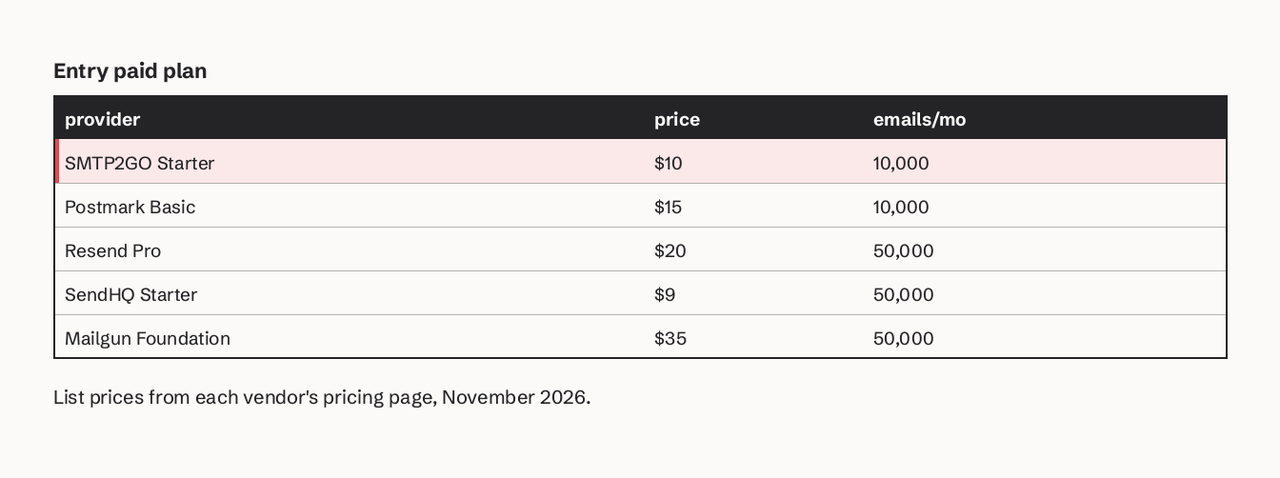
| Provider | Entry paid plan | Included emails | Overage per 1,000 | Free option | Inbound email | Log retention |
|---|---|---|---|---|---|---|
| SMTP2GO (baseline) | $10/mo | 10,000 | $1.00 | Free plan | Not listed on pricing page | 30 days |
| Postmark | $15/mo | 10,000 | $1.80 (Basic) | 100 emails/mo | Pro and Platform plans | 45 days (up to 365) |
| Mailgun | $15/mo | Basic plan | $1.80 (Basic) | 100 emails/day | 1 route free, full on Foundation | 1 to 5 days |
| Amazon SES | Pay as you go | None | $0.10 | AWS credits for new accounts | Yes (Mail Manager) | You build it |
| Resend | $20/mo | 50,000 | $0.90 | 3,000 emails/mo | Yes, 3 inboxes | 30 days |
| SendHQ | $9/mo | 50,000 | None (hard cap) | 100-delivery trial | Yes, every plan | Delivery events |
| Brevo | Starter | From 5,000 | Plan based | 300 emails/day | Not listed on pricing page | Unlimited logs |
1. Postmark
Postmark is a transactional email service from ActiveCampaign built around separating transactional and broadcast traffic into different "message streams," each with its own IP reputation.
- Best for: password resets, receipts and login codes where speed and clean logs matter more than unit price.
- Pricing: free Developer plan with 100 emails a month that never expires. Basic is $15 a month for 10,000 emails with extra email at $1.80 per 1,000; Pro is $16.50 ($1.30 overage) and Platform $18 ($1.20 overage) (Postmark pricing).
- Inbound: included on Pro and Platform, delivered as JSON to a webhook.
- Limits: 45-day activity retention by default, customizable up to 365 days on Pro and Platform. Postmark does not want bulk marketing on the transactional stream.
- Versus SMTP2GO: costs more per extra email but keeps logs 15 days longer by default and adds inbound parsing on the $16.50 plan.
2. Mailgun
Mailgun (part of Sinch) is an email API and SMTP service with mature inbound routing and email address validation.
- Best for: apps that route incoming mail by rules, such as support desks or reply-by-email features.
- Pricing: Free is $0 with 100 emails a day, 1 day of logs and 1 inbound route. Basic is $15 a month with extra email at $1.80 per 1,000 and 5 inbound routes. Foundation is $35 a month for 50,000 emails, $1.30 per extra 1,000, 5 days of logs and full inbound routing (Mailgun pricing).
- Limits: log retention is short on lower plans (1 day on Free and Basic, 5 days on Foundation), so plan to stream events to your own storage.
- Versus SMTP2GO: stronger inbound and validation, much shorter default log history.
3. Amazon SES
Amazon Simple Email Service is AWS's sending and receiving infrastructure, priced per email with no monthly minimum on its a la carte option.
- Best for: high volume senders already on AWS who can build their own dashboards and bounce handling.
- Pricing: a la carte outbound email is $0.10 per 1,000 emails plus $0.12 per GB of attachments. The newer plans charge $0.16 (Essentials), $0.22 (Pro, plus $105 a month) or $0.23 (Enterprise, plus $500 a month) per 1,000 for the first 10 million emails (Amazon SES pricing). New AWS customers get up to $200 in Free Tier credits.
- Inbound: yes, through receipt rules or Mail Manager, which bills incoming mail separately.
- Limits: new accounts start in the SES sandbox and must request production access; there is no built-in long-term log viewer, so you wire events through SNS, EventBridge or CloudWatch.
- Versus SMTP2GO: 100,000 emails cost about $10 at the a la carte rate against $75 on SMTP2GO Professional, in exchange for doing the operations work yourself.
4. Resend
Resend is a developer-first email API with SDKs for most languages, React Email support, SMTP relay and inbound email.
- Best for: product teams writing new code in TypeScript, Python or Go who want a clean REST API and a usable free tier.
- Pricing: Free is $0 for 3,000 emails a month (100 a day) with 30-day retention. Pro is $20 a month for 50,000 emails and Scale is $90 for 100,000, both with extra email at $0.90 per 1,000. Dedicated IPs are a $30 a month add-on on Scale above 3,000 emails a day (Resend pricing).
- Inbound: included, with 3 inboxes per plan and $1 per extra inbox on paid plans.
- Limits: the free plan's 100 emails a day cap rules it out for anything beyond testing and small side projects.
- Versus SMTP2GO: five times the included volume at the $20 tier, plus inbound and signed webhooks.
5. SendHQ
SendHQ is our product: a Resend-compatible email API for applications and AI agents, sending through Amazon SES, with inbound email and delivery events on every plan.
- Best for: teams that want SES economics without building SES tooling, and agents that need to both send and receive.
- Pricing: Starter Transactional is $9 a month for 50,000 emails; Scale is $39 a month for 200,000. There are no overage charges: once the monthly allowance is used, sends are rejected with a usage-limit error until the next month or an upgrade (SendHQ pricing).
- Limits: there is no free plan, only a 100-delivery integration trial to your own address or the SES simulator. Each new sender address starts at 2,000 recipients a day and rises to 10,000 and then 50,000 after clean sending, and senders with rising bounce or complaint rates are throttled or paused automatically.
- Versus SMTP2GO: more included volume for less, inbound on the entry plan, and a hard monthly cap instead of open-ended overage. It is a younger product with a smaller track record.
6. Brevo
Brevo (formerly Sendinblue) is a marketing platform whose plans all include transactional email over REST API and SMTP.
- Best for: small businesses that want transactional and marketing email in one account and one bill.
- Pricing: the free plan sends up to 300 emails a day once the account is approved; paid Starter plans begin at 5,000 emails a month, priced by volume (Brevo pricing).
- Logs: Brevo states that all plans include outbound webhooks and unlimited log retention.
- Limits: the product is centred on marketing contacts and campaigns, so developer ergonomics and inbound handling are secondary.
- Versus SMTP2GO: better for mixed marketing plus transactional use, less focused for app-only sending.
How do you choose an SMTP2GO alternative?
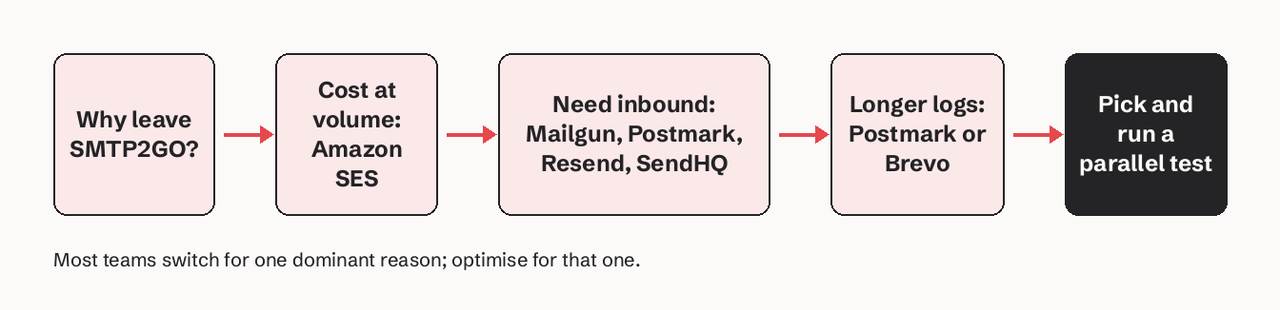
Start with the reason you are leaving, then match it:
| If you need | Choose |
|---|---|
| Lowest cost per email at 100,000+ a month | Amazon SES |
| Fast transactional delivery and long logs | Postmark |
| Rule-based inbound routing and validation | Mailgun |
| A modern API with a real free tier | Resend |
| SES pricing with inbound and events, no overage bills | SendHQ |
| Transactional plus marketing in one tool | Brevo |
Whatever you pick, migrate in this order: add the new provider's DKIM and SPF records next to the old ones (SPF allows only one record, so merge the include: entries), send a small share of traffic through the new provider, compare bounce and complaint rates for a week, then move the rest. Our transactional email migration playbook covers each step, and the email API pricing guide models costs at other volumes.
Which SMTP2GO alternatives support both SMTP and a REST API?
Postmark, Mailgun, Amazon SES, Resend and Brevo all offer an SMTP endpoint and a REST API, so you can keep a legacy SMTP integration (a WordPress plugin, a printer, an old framework) while new services call the API. SendHQ is API-first and Resend-compatible. If you only need a drop-in relay, see our SMTP relay service guide.
If your next problem after switching is receiving replies and tracking every bounce without building that pipeline on SES, SendHQ gives you inbound email, delivery events and verified-domain sending on the $9 plan.
FAQ
What are the best SMTP2GO alternatives?
Postmark, Mailgun, Amazon SES, Resend, SendHQ and Brevo are the most common replacements. Postmark suits transactional speed, Mailgun inbound routing, Amazon SES low cost at volume, Resend a modern API, SendHQ SES pricing with inbound included, and Brevo combined marketing and transactional email.
Which SMTP2GO alternative has the best free plan?
Resend's free plan is the most generous for developers at 3,000 emails a month, capped at 100 a day. Brevo allows 300 emails a day on its free plan, Mailgun 100 a day, and Postmark 100 a month. Amazon SES has no permanent free plan but gives new AWS customers up to $200 in credits.
Which alternatives support inbound email?
Mailgun (routes), Postmark (Pro and Platform plans), Amazon SES (receipt rules and Mail Manager), Resend (3 inboxes per plan) and SendHQ (every plan) can all receive email and pass it to your application. Our transactional email API guide covers what to check in each one.
Is Amazon SES cheaper than SMTP2GO?
Yes, at any meaningful volume. SES a la carte charges $0.10 per 1,000 emails, so 100,000 emails cost about $10 plus attachment data, against $75 a month for SMTP2GO Professional. The trade-off is setup: sandbox approval, DNS, and your own event pipeline.
Can I keep using SMTP after leaving SMTP2GO?
Yes. Change the host, port (587 with STARTTLS or 465 with implicit TLS), username and password in your application, and authenticate your domain with the new provider's DKIM record before switching traffic. Our SMTP port 587 vs 465 vs 25 guide explains which port to choose.