
Deliverability
Email RFC Resources: 24 Standards and Tools Worth Using
The core email RFCs are RFC 5321 (SMTP) and RFC 5322 (message format). Here are 24 RFCs, drafts and tools, with 2026 updates like DMARC RFC 9989.
Published · Updated
TL;DR: The two email RFCs everything else builds on are RFC 5321 (SMTP, how mail moves) and RFC 5322 (Internet Message Format, what a message looks like). Around them sit MIME, SPF, DKIM, DMARC, TLS and bounce-report RFCs, and two of those changed in 2026: DMARC is now RFC 9989 and TLS 1.3 is RFC 9846. SendHQ is an email API that handles the SPF, DKIM and DMARC side for each verified domain and reports delivery events, so you can read these specs to understand the behaviour rather than to reimplement it.
Start building with SendHQ or read the SendHQ docs to see how a verified domain maps onto these standards.
What is the email RFC? There is not one. "Email RFC" usually means RFC 5322, the Internet Message Format that defines headers like From, To, Date and Message-ID, and its partner RFC 5321, the Simple Mail Transfer Protocol. Both were published in October 2008, replacing RFC 2822/822 and RFC 2821/821. The IETF EMAILCORE working group is revising both (drafts rfc5321bis and rfc5322bis, last updated in November 2026), but until those drafts are published as RFCs, 5321 and 5322 are the current text. The list below groups the RFCs, drafts and tools by job, with a one-line reason to open each.
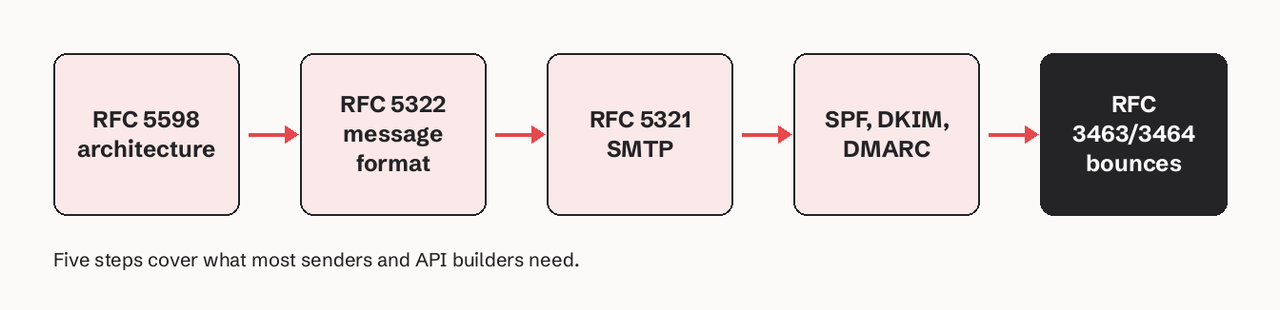
Start here: a reading path in five steps
If you are new to the specs, read in this order. Each step builds on the one before it.
- Read RFC 5598 for the map of who does what (MUA, MSA, MTA, MDA).
- Read RFC 5322 sections 3.3 to 3.6 for the header fields your code writes.
- Read RFC 5321 sections 3 and 4 for the SMTP dialogue and reply codes.
- Read RFC 7208, RFC 6376 and RFC 9989 for SPF, DKIM and DMARC.
- Read RFC 3463 and RFC 3464 so bounce messages stop being mysterious.
How SendHQ uses these standards for you
SendHQ is "One API. Every email use case." In practice that means the standards below are handled per domain and per message:
- Domain authentication (RFC 7208, RFC 6376, RFC 9989): when you add a domain, SendHQ gives you the SPF, DKIM and DMARC records to publish, and only sends from verified domains. The DKIM setup guide and the SPF, DKIM and DMARC guide walk through each record.
- Message format (RFC 5322, MIME): you send JSON (
from,to,subject,html) to the REST API and the message is built for you. - Bounces and complaints (RFC 3463, RFC 3464): delivery, bounce and complaint outcomes come back as delivery events, so you read a status instead of parsing a DSN. See email bounce handling.
- Inbound (RFC 5321 on the receiving side): inbound webhooks hand you received mail as data.
What it does not do: it is not an SMTP server you configure yourself, so if you need to tune MTA behaviour from RFC 5321 directly, you need your own MTA.
Core message and transport RFCs
- RFC 5322: Internet Message Format: the syntax of every header and body you send; open it when a header is rejected or misparsed.
- RFC 5321: Simple Mail Transfer Protocol: the SMTP commands (EHLO, MAIL FROM, RCPT TO, DATA) and reply codes; the reference for any 4xx or 5xx you see. Our SMTP commands list is the short version.
- RFC 5598: Internet Mail Architecture: informational, July 2009; the clearest explanation of the roles and terms the other RFCs assume.
- RFC 6409: Message Submission for Mail: why apps submit on port 587 rather than 25; an Internet Standard since 2011.
- draft-ietf-emailcore-rfc5321bis: the next SMTP spec, at revision 44 (updated 2026-11-11); read its change appendix to see which ambiguities are being fixed.
- draft-ietf-emailcore-rfc5322bis: the next message-format spec, at revision 12 (updated 2026-11-04).
MIME and international email
- RFC 2045: MIME Part One: Content-Type and Content-Transfer-Encoding; the start of the five-part MIME suite (2045 to 2049) behind HTML mail and attachments.
- RFC 6531: SMTP Extension for Internationalized Email: the SMTPUTF8 extension for non-ASCII addresses.
- RFC 6532: Internationalized Email Headers: UTF-8 in header fields; read with 6531.
Authentication: SPF, DKIM, DMARC, ARC
- RFC 7208: SPF: which IPs may send for a domain, including the 10 DNS-lookup limit covered in our SPF flattening guide.
- RFC 6376: DKIM Signatures: the signature and
DKIM-Signatureheader format; an Internet Standard. - RFC 9989: DMARC: published May 2026, obsoletes RFC 7489 and RFC 9091; the current DMARC text. Existing
v=DMARC1records keep working. - RFC 9990: DMARC Aggregate Reporting: the format of the
ruaXML reports you receive. - RFC 9991: DMARC Failure Reporting: the
rufper-message reports. - RFC 8617: ARC: experimental (July 2019); keeps authentication results across forwarders and mailing lists.
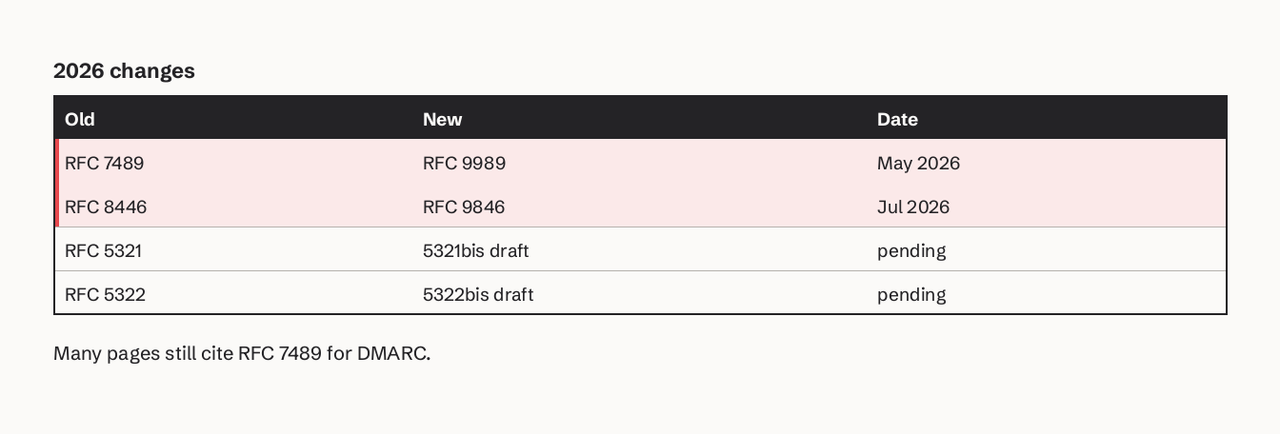
| Standard | Old RFC | Current RFC | Changed |
|---|---|---|---|
| DMARC | RFC 7489 | RFC 9989, 9990, 9991 | May 2026 |
| TLS 1.3 | RFC 8446 | RFC 9846 | July 2026 |
| SMTP | RFC 2821 | RFC 5321 (5321bis in draft) | Oct 2008 |
| Message format | RFC 2822 | RFC 5322 (5322bis in draft) | Oct 2008 |
Transport security
- RFC 8314: Cleartext Considered Obsolete: recommends implicit TLS (port 465) for submission; the background to our port 587 vs 465 vs 25 guide.
- RFC 3207: STARTTLS for SMTP: upgrading a plain connection to TLS.
- RFC 9846: TLS 1.3: July 2026, obsoletes RFC 8446.
- RFC 8461: MTA-STS: lets a receiving domain require TLS from senders.
- RFC 8460: SMTP TLS Reporting: daily reports of TLS failures to your domain.
Bounces and unsubscribe
- RFC 3463: Enhanced Mail System Status Codes: the
5.1.1-style codes inside bounces; see our SMTP error code list. - RFC 3464: Delivery Status Notifications: the machine-readable bounce format.
- RFC 8058: One-Click Unsubscribe: the
List-Unsubscribe-Postheader that large mailbox providers ask bulk senders for. - RFC 2369: List header fields: defines
List-Unsubscribeand related headers.
A bounce you will see in practice reads like this:
Status: 5.1.1
Diagnostic-Code: smtp; 550 5.1.1 The email account that you tried to reach does not exist
550 is the RFC 5321 reply code; 5.1.1 is the RFC 3463 enhanced code (5 = permanent, 1.1 = bad mailbox).
Tools for reading RFCs
- RFC Editor email subject index: every email RFC by topic, from the official publisher.
- IETF Datatracker: draft status, revision history and which RFC obsoletes which.
- RFC Editor errata search: reported mistakes in published RFCs; check it before trusting an edge case.
- Fastmail on the core spec revision: a short, readable account of what EMAILCORE is changing and why.
- Python email package RFC list: which RFCs a real mail library implements.
Which email RFCs matter for an API sender?
If you send through an API, five matter day to day: RFC 5322 (headers you set), RFC 7208, RFC 6376 and RFC 9989 (whether your domain authenticates), and RFC 3463 (what a bounce means). The rest explain behaviour your provider handles.
FAQ
What is the RFC for email format?
RFC 5322, Internet Message Format, published October 2008. It replaced RFC 2822, which replaced RFC 822.
What is the RFC for SMTP?
RFC 5321, published October 2008. Its revision, rfc5321bis, is still an Internet-Draft as of November 2026.
Is RFC 7489 still the DMARC standard?
No. RFC 9989 (May 2026) obsoletes it, with reporting split into RFC 9990 and RFC 9991. v=DMARC1 records stay valid.
What RFC defines a valid email address?
RFC 5322 section 3.4.1 defines addr-spec (local-part@domain); RFC 5321 sets length limits for SMTP, and RFC 6531 adds UTF-8 addresses.
Do I need to read RFCs to send email from an app?
No. An email API such as SendHQ handles the protocol. The RFCs help you debug headers, authentication and bounces.
Ready to put the standards to work? Start building with SendHQ and follow the quickstart to send your first email from a verified domain.